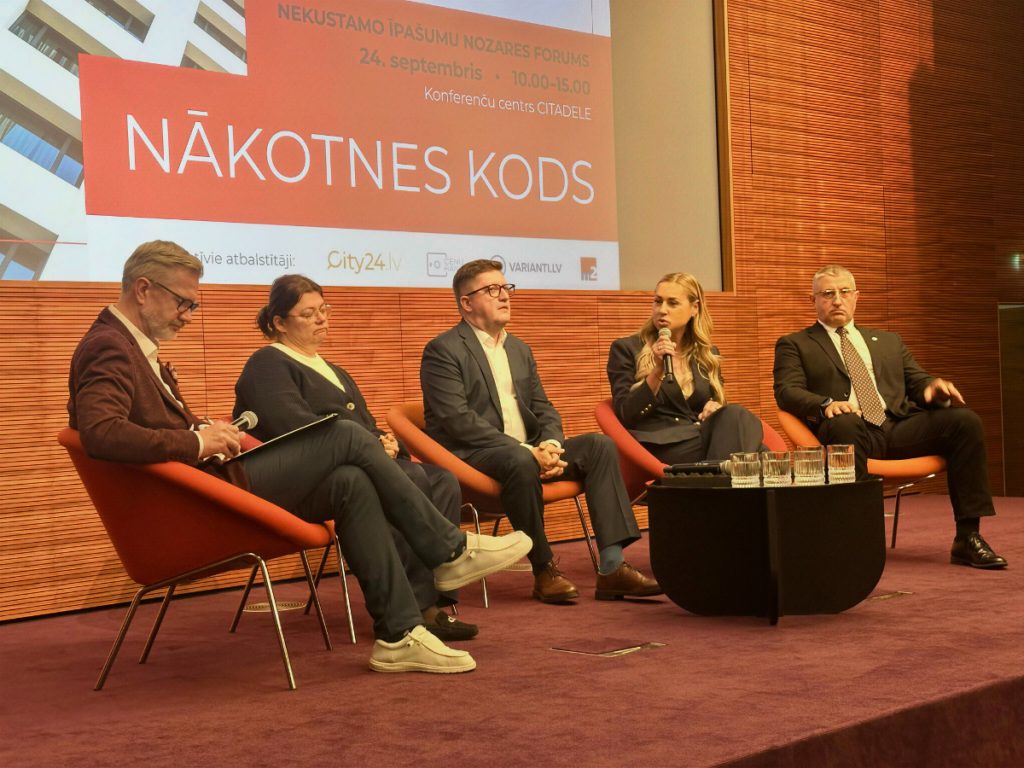
On 24th of September, the real estate industry forum “Nākotnes kods” explored how Latvia’s property market may develop through 2030. How will housing prices and demand change? Will household incomes keep pace with costs? What role will tax policy, the rental market and the future of central Riga play?
Līga Plaude, a board member of LANĪDA, shares ten predictions for the years ahead. In her view, prices are likely to rise moderately, while total housing costs, buyers’ purchasing power and property quality will become increasingly important.
1. Prices will rise moderately
Overall, housing prices are likely to remain relatively stable, with modest growth. There is currently little reason to expect a broad, rapid increase. At the same time, the value of individual properties will diverge more noticeably: a well-maintained home in a suitable location will be more attractive than one requiring substantial investment after purchase.
2. The industry will need clarity on tax policy
One of the key questions concerns the future of real estate tax and how property values are determined for tax purposes. This issue has been discussed for years, yet owners and investors still need greater predictability. Clear rules announced in good time would help them make better-informed long-term decisions.
3. Buyers will continue to have a wide choice
In many market segments, buyers will be able to compare several similar properties and assess asking prices carefully. Sellers will therefore need to set a market-appropriate price, prepare their property for sale and clearly demonstrate its advantages. Conditions will, however, vary between neighbourhoods and property segments.
4. Housing affordability will depend on household purchasing power
An increasingly important question will be whether local families’ incomes can keep pace with housing prices and running costs. Buyers will consider not only the price per square metre, but also monthly mortgage payments, utility bills and potential renovation costs. If total costs rise faster than incomes, some families will choose a smaller home or postpone their purchase.
5. The rental market will continue to develop
Rental homes will remain relevant for people who want flexibility, are still saving for a down payment or plan to stay in Latvia for a limited period. As a result, a property’s quality, running costs and management will matter alongside its location.
6. Demographics will shape demand for larger apartments
Demand for homes with two or three bedrooms will depend on how many families can afford more space and choose to build their future in Latvia. Attracting international students and workers could also broaden the pool of tenants. Investors will nevertheless need to assess actual demand in a specific neighbourhood rather than assume that any apartment will be easy to rent out.
7. The price gap between new developments and existing homes may widen
Construction and development costs will continue to influence prices in new projects. The price gap between new homes and some properties on the resale market could therefore widen. When comparing options, buyers will also need to consider energy efficiency, the building’s technical condition and the investment required after purchase.
8. The future of central Riga will depend on the quality of its living environment
Homes in central Riga can still be found at relatively attractive prices. Price alone, however, will not persuade people to live there permanently. The condition of buildings, the surrounding environment and everyday conveniences will all matter. Efforts to revitalise the city centre have so far been fragmented; realising its potential will require a coordinated approach sustained over the long term.
9. Postponing a home purchase will not always pay off
If buyers find a property that meets their needs and fits their budget, they should not base their decision solely on the hope of a substantial price drop. This does not mean that every purchase, at any price, is a good one. What matters is checking the individual property, calculating the full costs and keeping an adequate financial reserve.
10. Artificial intelligence will support decision-making
AI tools will help people gather listings, compare property features and analyse prices more quickly. Yet every property has circumstances that listing data alone cannot capture. Professional experience will remain valuable when assessing a property and its documents, understanding the parties’ interests and conducting negotiations.
In the years ahead, careful assessment will give market participants an advantage. For buyers, that means looking beyond the listing price; for sellers, explaining the value of their property; and for the industry as a whole, achieving greater clarity on tax policy and urban development.